The Digital Receipt
From checkout to customer: the complete e-receipt architecture. How receipts enter Limpidius, how they are distributed in real time, how they are stored and presented across all surfaces.
What the digital receipt looks like.
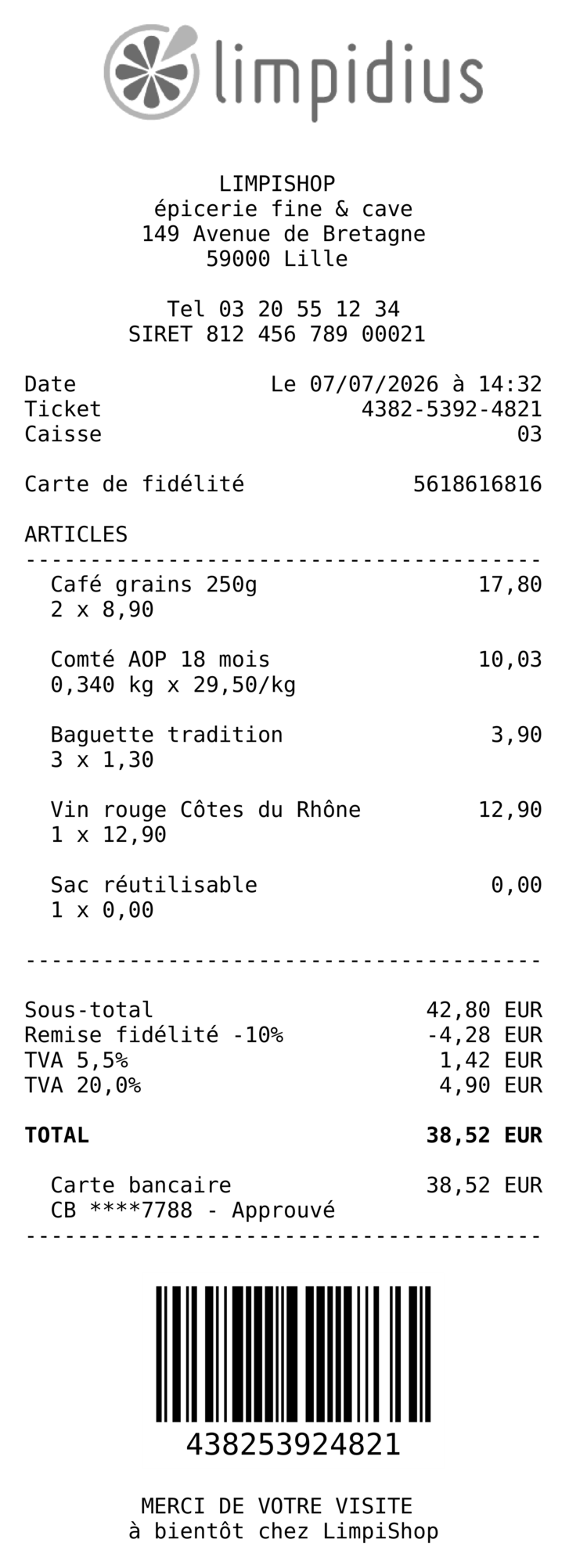
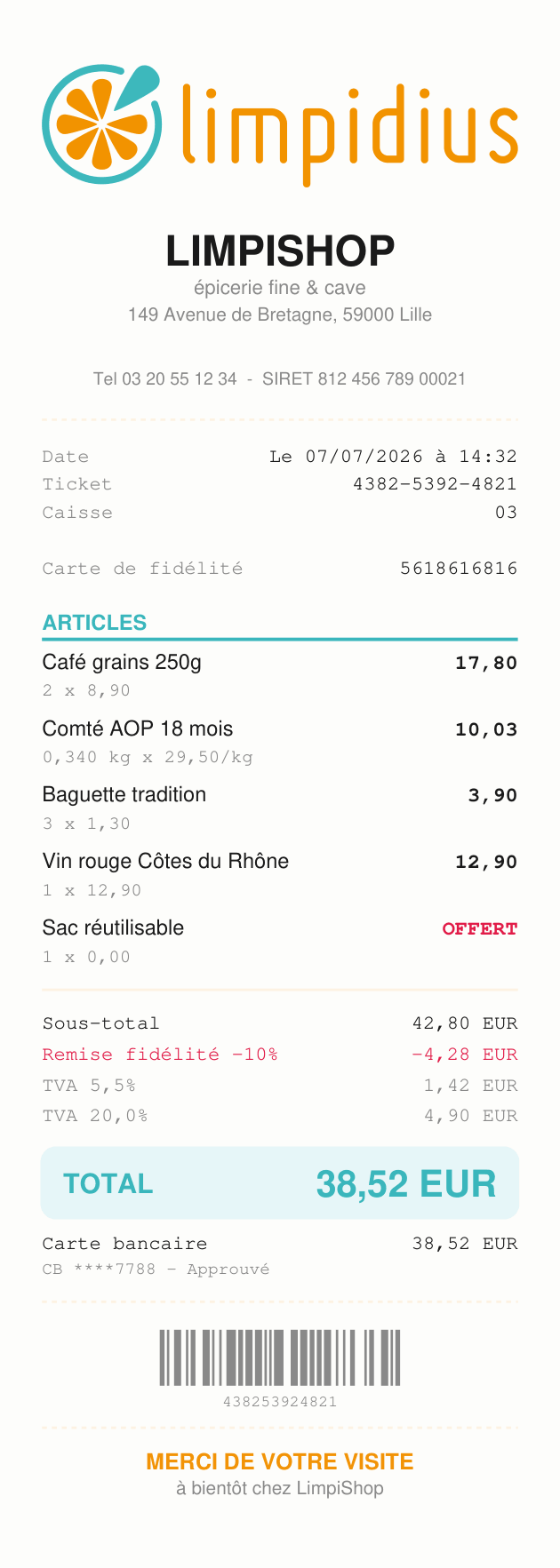
Three ways to feed Limpidius.
Every retailer, every POS publisher has their own technical constraints. Limpidius offers three integration methods (from the universal local component to the modern open-access API) so no checkout stays outside the network.
Without EdgarPOS, Socrate or Platon receiving the receipt, Limpidius has nothing to distribute, store or display. A checkout that doesn't transmit stays invisible to the entire infrastructure.
Installed as a complementary module on top of any POS software. Compatible with 100% of market POS systems, with no specific development required from the publisher.
EdgarPOS handles customer choices live: print, receive by email, display a QR code, or skip the receipt entirely. It collects GDPR consent and carries fifteen years of field intelligence to handle edge cases: network micro-outages, missing paper, resend attempts.
The retailer or POS publisher transmits the print commands intended for the thermal printer to Socrate via a single request.
Socrate processes all transactional documents (receipts, card slips, ticket or A4 invoices) as well as customer metadata and consents.
For POS publishers capable of transmitting structured data (JSON / XML). Platon generates transactional documents in Limpidius's proprietary format, a modern aesthetic that goes beyond reproducing the paper receipt.
Available in open access on this site, and favoured by next-generation POS software for restaurants and specialist retail.
Two immediate actions: the e-receipt lands before the customer even leaves the checkout.
As soon as Socrate or Platon receives the data, the pipeline triggers instantly on two channels. The customer receives their receipt before putting their wallet away.
Nestor Stores: the presentation backbone.
After real-time distribution, Nestor Stores takes over for the entire subsequent life of the receipt. Three consultation surfaces, four access channels, every customer finds their receipt where they look for it.
WebReceipt
The enriched, interactive receipt. Accessible from the checkout QR code, email or directly from the customer space. PDF download, access to Arthur (invoicing), Phil Goods (products), loyalty balance.
WebArchive
The aggregated history of all a customer's purchases for a retailer. Destination interface from the Wallet or customer space. Fully customisable in the brand's colours.
Nestor API
Integration of a "My Receipts" tab in the retailer's website or app. Filtering by date, payment method, amount. Minimum development on the retailer side, Nestor Stores exposes everything.
No customer without their receipt.
Identified or not, cardholder or anonymous visitor, the four channels cover all profiles.
The modules that enrich the receipt.
WebReceipt and WebArchive are the starting point. Each Limpidius infrastructure module extends their capabilities from these surfaces.
The e-receipt in practice.
What retailers ask us most often before integrating the infrastructure.
What is an e-receipt?
An e-receipt is the transaction document issued at the checkout and handed to the customer digitally rather than printed. At Limpidius it is produced at transaction time by EdgarPOS, Socrate or Platon, then distributed by email, QR code, customer account or mobile wallet.
What is the difference between an e-receipt and a digital receipt?
None. Both name the same object: the till receipt handed to the customer without paper. 'E-receipt' is the short form used across European retail, 'digital receipt' the longer one. The Limpidius infrastructure covers both.
How do I integrate e-receipts with my POS software?
Three routes, depending on your technical maturity: EdgarPOS, a local component compatible with 100% of the POS systems on the market; the Socrate API, which takes over the existing print stream in a single request; the Platon API, for checkouts able to emit structured JSON or XML. Platon is openly available.
Does the customer need an app to receive an e-receipt?
No. The e-receipt opens in a browser through the WebReceipt, arrives by email, or is scanned as a QR code from the checkout screen. Adding it to an Apple or Google wallet stays optional.
How long is an e-receipt stored?
Nestor Stores handles permanent storage and exposure. Retention periods and purge rules are configured by the retailer according to its legal obligations and GDPR policy.
What can an e-receipt do beyond proof of purchase?
From the WebReceipt, Arthur la Facture issues the invoice, Phil Goods enriches every product line, Homer le Customer links the transaction to the customer profile, and Virgil le Vigile covers exit control.
Integrate Limpidius into your checkout.
Three integration methods according to your technical maturity. The Platon API is available in open access right now.